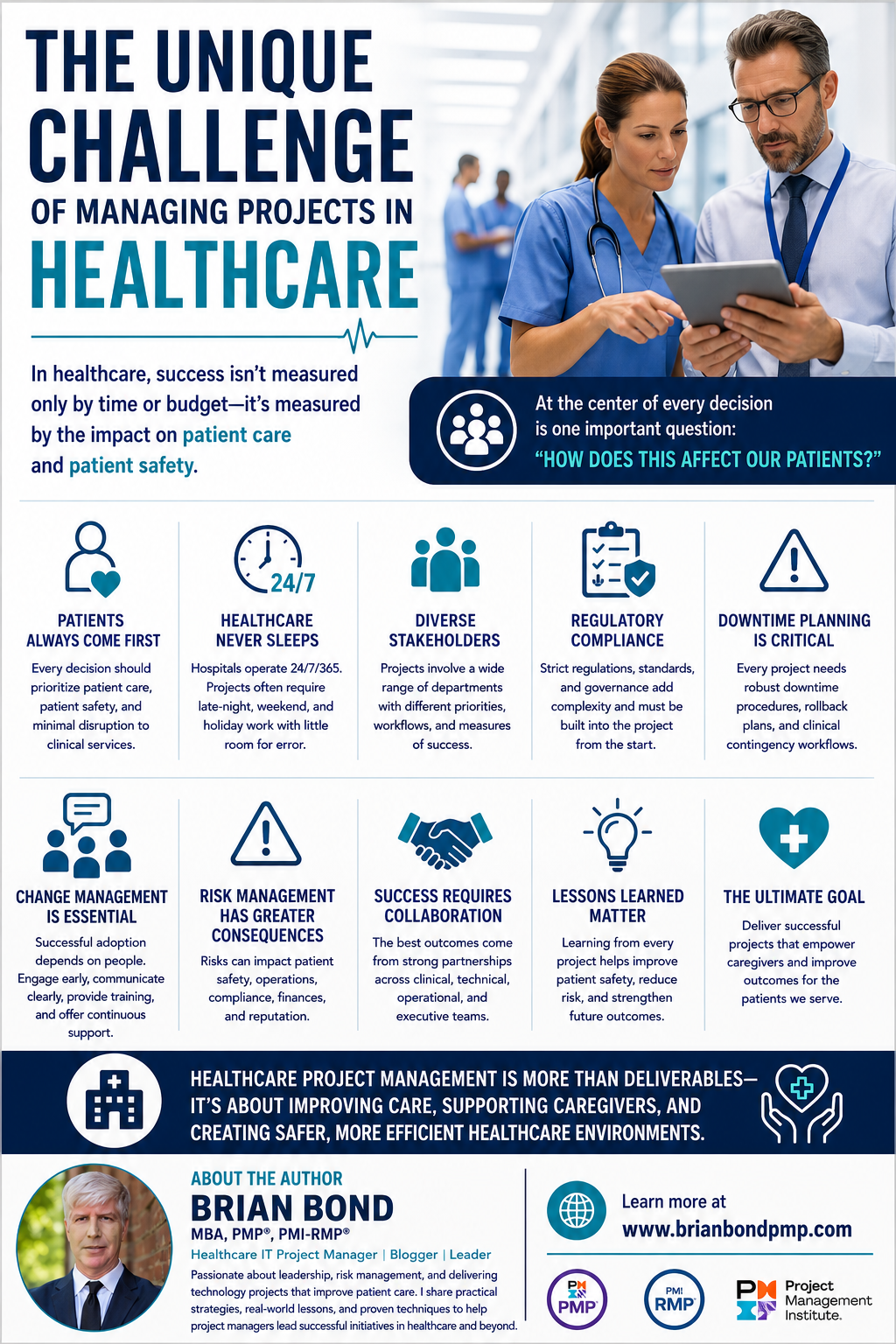
Healthcare project management is unlike project management in almost any other industry. While every project manager must balance scope, schedule, cost, quality, and risk, healthcare adds an additional dimension that influences every decision: patient care and patient safety.
Whether you’re implementing a new Electronic Health Record (EHR), deploying medical equipment, upgrading network infrastructure, renovating clinical space, or introducing cybersecurity controls, success isn’t measured solely by finishing on time and under budget. Success is measured by whether patient care continues safely and effectively throughout the project.
Patients Always Come First
In many industries, a delayed project may impact revenue or productivity. In healthcare, poor planning can directly affect patient outcomes.
Project managers must constantly ask:
- Will this change impact patient care?
- Can clinicians continue providing care during implementation?
- What is our downtime plan if something fails?
- How do we minimize disruption to patients and staff?
Every decision should begin with the question:
“How does this affect our patients?”
Healthcare Never Sleeps
Unlike traditional businesses that operate Monday through Friday, hospitals operate:
- 24 hours a day
- 7 days a week
- 365 days a year
There is rarely a convenient maintenance window.
Projects often require:
- Late-night implementations
- Weekend cutovers
- Holiday work
- Careful coordination with clinical leadership
Even then, emergencies can immediately change priorities.
A planned server upgrade may suddenly be postponed because the Emergency Department experiences an unexpected surge of patients.
Flexibility becomes one of a healthcare project manager’s greatest strengths.
Stakeholders Are More Diverse
Healthcare projects involve an unusually large number of stakeholders.
A single project may require coordination between:
- Executive leadership
- Physicians
- Nurses
- Pharmacy
- Laboratory
- Radiology
- Biomedical Engineering
- Information Technology
- Facilities Management
- Supply Chain
- Infection Prevention
- Compliance
- Security
- Finance
- Vendors
Each department has different priorities, terminology, workflows, and measures of success.
Building strong relationships and maintaining open communication are often more important than technical expertise alone.
Regulatory Requirements Add Complexity
Healthcare projects must comply with numerous regulations and standards.
Depending on the project, this may include:
- Privacy and security requirements
- Documentation standards
- Accreditation requirements
- Medical device regulations
- Internal governance
- Cybersecurity policies
Compliance activities should never be treated as afterthoughts. They should be incorporated into project planning from the beginning.
Downtime Planning Is Critical
One of the biggest differences in healthcare is planning for failure.
Every major implementation should include:
- Downtime procedures
- Rollback plans
- Clinical contingency workflows
- Emergency contact lists
- Command center support
- Executive communication plans
Hope is never a strategy.
Healthcare organizations expect project managers to prepare for what happens if technology doesn’t work exactly as planned.
Change Management Is Essential
Healthcare professionals already operate in high-stress environments.
Adding new technology or changing established workflows can create resistance if not managed properly.
Successful healthcare project managers focus on:
- Early stakeholder engagement
- Clinical champions
- End-user training
- Hands-on support
- Clear communication
- Continuous feedback
Technology adoption is ultimately about people, not systems.
Risk Management Has Greater Consequences
Every project carries risk.
In healthcare, those risks may include:
- Delayed patient care
- Medication errors
- Device failures
- Cybersecurity incidents
- Regulatory violations
- Financial penalties
- Reputational damage
Because of this, healthcare organizations often place significant emphasis on maintaining living risk registers and reviewing risks throughout the project lifecycle rather than only during planning.
Success Requires Collaboration
Healthcare projects are rarely accomplished by a single department.
The best project managers become facilitators who bring together clinical teams, technical experts, vendors, executives, and frontline staff around a common objective.
Listening is often more valuable than directing.
The ability to translate technical language into clinical value—and vice versa—is one of the most valuable skills a healthcare project manager can develop.
Lessons Learned Matter
Every healthcare project provides opportunities to improve future work.
Conducting structured lessons learned sessions helps organizations:
- Improve patient safety
- Reduce implementation risk
- Shorten future project timelines
- Improve communication
- Build organizational knowledge
Organizations that continuously learn become better prepared for increasingly complex healthcare initiatives.
Final Thoughts
Healthcare project management is challenging because the work extends far beyond schedules and deliverables. It requires balancing technology, operations, regulations, clinical workflows, and organizational priorities—all while ensuring uninterrupted patient care.
For me, that’s what makes healthcare project management so rewarding. Every successful implementation supports the clinicians who deliver care and, ultimately, improves outcomes for the patients who rely on them.
The best healthcare project managers don’t just deliver projects—they help create safer, more efficient environments where caregivers can focus on what matters most: caring for patients.
About the Author
I’m Brian Bond, an MBA graduate in IT Management, PMP®, PMI-RMP®, and experienced Healthcare IT Project Manager with a passion for leadership, risk management, and delivering technology projects that improve patient care. Through my blog, I share practical strategies, real-world lessons, and proven techniques to help project managers lead successful initiatives in healthcare and beyond. Learn more at https://www.brianbondpmp.com.
Check out My other blogs at