By Brian Bond, MBA, PMP, PMI-RMP, CISSP
Managing a project would be much easier if success depended only on building a schedule, managing a budget, tracking risks, and completing tasks.
But projects involve people.
And people bring different priorities, personalities, pressures, communication styles, and expectations.
One of the most important skills a project manager can develop is the ability to handle difficult stakeholder situations professionally.
The goal isn’t to avoid conflict. It’s to manage conflict without damaging relationships, losing credibility, or allowing the project to lose direction.
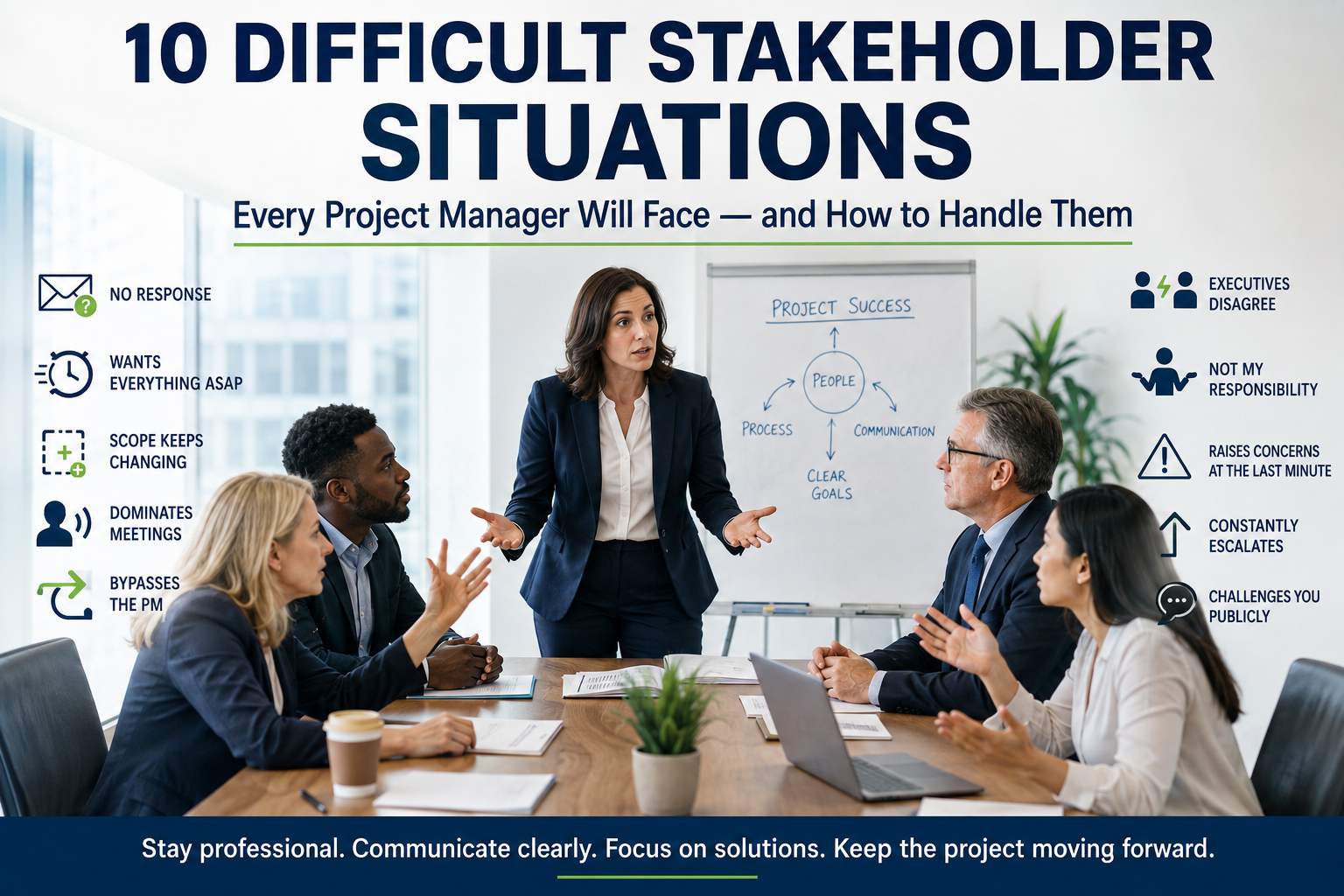
Here are 10 situations almost every project manager will eventually face—and some practical ways to handle them.
1. The Stakeholder Who Never Responds
You send an email.
Nothing.
You send a follow-up.
Still nothing.
Meanwhile, the project is waiting on their decision.
The Wrong Approach
Continuing to send increasingly frustrated emails or waiting indefinitely.
A Better Approach
Make the impact of the missing decision clear.
Instead of:
“Just following up again.”
Try:
“We need a decision by Thursday to maintain the current implementation date. If we’re unable to make the decision by then, I’ll update the schedule to reflect the potential delay.”
You’re no longer simply asking for a response.
You’re communicating a project impact.
PM Lesson
Don’t chase people forever. Make dependencies and consequences visible.
2. The Stakeholder Who Wants Everything ASAP
Some stakeholders believe everything is the highest priority.
They want every request completed immediately.
The problem is that when everything is urgent, nothing is truly prioritized.
The Wrong Approach
Accepting every request and forcing the project team to figure it out.
A Better Approach
Ask the stakeholder to prioritize.
Try:
“We can move this request forward, but we’ll need to shift resources from another priority. Which item would you like us to move?”
Now the stakeholder has to participate in the tradeoff.
PM Lesson
Project managers shouldn’t absorb impossible priorities. Make the tradeoffs visible.
3. The Executive Who Keeps Adding Scope
An executive asks:
“While we’re doing this, can we also add…”
Sometimes the request sounds small.
But small requests accumulate.
Before long, the project has expanded significantly without corresponding changes to budget, resources, or schedule.
The Wrong Approach
Immediately saying yes because the request came from an executive.
A Better Approach
Acknowledge the value of the request while evaluating the impact.
Try:
“That’s something we can evaluate. Let me have the team determine the impact to cost, resources, and timeline so we can make an informed decision.”
This isn’t saying no.
It’s introducing governance.
PM Lesson
Every scope change has a cost—even when the person requesting it is an executive.
4. The Stakeholder Who Dominates Meetings
Some stakeholders interrupt constantly, take conversations off topic, or turn every meeting into their meeting.
This can prevent quieter stakeholders from contributing and make meetings ineffective.
The Wrong Approach
Allowing the behavior to continue because you’re uncomfortable interrupting a senior stakeholder.
A Better Approach
Politely redirect the conversation.
Try:
“That’s an important point. I’d like to capture it in the parking lot so we can finish today’s decision, and then we can come back to it.”
Or:
“I’d like to hear from some of the other teams before we make the decision.”
PM Lesson
Facilitating a meeting sometimes means respectfully taking control of the room.
5. The Stakeholder Who Bypasses the Project Manager
A stakeholder begins giving instructions directly to team members.
Tasks change.
Priorities shift.
And suddenly you’re discovering project decisions after they’ve already been made.
The Wrong Approach
Turning it into a territorial battle about who is “in charge.”
A Better Approach
Focus on coordination rather than authority.
Try:
“I’m happy for you to work directly with the team. I just need to make sure changes come through the project process so we can evaluate dependencies and keep the schedule accurate.”
PM Lesson
Governance isn’t about protecting the project manager’s authority. It’s about protecting the project.
6. Two Executives Strongly Disagree
This can be one of the most uncomfortable situations for a project manager.
Two senior leaders want different outcomes, and both expect the project team to move forward.
The Wrong Approach
Choosing the person you believe is right.
A Better Approach
Define the decision clearly.
Document:
- Option A
- Option B
- Benefits
- Risks
- Cost
- Schedule impact
- Operational impact
- Recommended decision date
Then facilitate the decision.
PM Lesson
Your job isn’t always to make the decision. Sometimes your job is to create the conditions for the right people to make it.
7. The Stakeholder Who Says, “That’s Not My Responsibility”
Projects often require work that crosses organizational boundaries.
Eventually, you may encounter an important task with no clear owner.
Everyone agrees it needs to happen.
Nobody wants to own it.
The Wrong Approach
Assigning the task to someone without agreement and hoping they complete it.
A Better Approach
Clarify the responsibility and escalate ownership when necessary.
Try:
“We have an ownership gap that could affect the implementation date. We need to identify who has accountability for this activity before Friday.”
A RACI matrix can also help identify these gaps before they become problems.
PM Lesson
Unclear ownership eventually becomes project risk.
8. The Stakeholder Who Raises Major Concerns Right Before Go-Live
The project has been running for months.
Requirements were reviewed.
Testing was completed.
Training has started.
Then someone says:
“I don’t think we’re ready.”
The Wrong Approach
Becoming defensive and listing every opportunity they previously had to raise concerns.
A Better Approach
Ask one important question:
“What specific risk do you believe prevents us from going live?”
Now you’ve moved the conversation from emotion to risk.
Evaluate the concern based on probability, impact, mitigation, and organizational risk tolerance.
Sometimes the concern is legitimate.
Sometimes it isn’t.
Either way, evaluate it professionally.
PM Lesson
Late concerns are frustrating, but timing doesn’t automatically make a concern invalid.
9. The Stakeholder Who Constantly Escalates
Some stakeholders escalate almost every issue to senior leadership.
This can make the project manager feel undermined.
The Wrong Approach
Escalating back.
A Better Approach
Try to understand why the stakeholder doesn’t trust the normal project process.
Ask:
“I’d like to make sure we’re addressing issues quickly enough. What information or response would help you feel comfortable resolving these items within the project team?”
You may discover that the actual problem is communication, visibility, or trust.
PM Lesson
Frequent escalation is often a symptom of a relationship problem rather than a project problem.
10. The Stakeholder Who Challenges You Publicly
Eventually, someone may challenge your schedule, decision, recommendation, or credibility during a meeting.
Your instinct may be to defend yourself immediately.
Resist it.
The Wrong Approach
Turning the meeting into an argument.
A Better Approach
Stay calm.
Ask questions.
Try:
“That’s a fair concern. Can you walk me through what you’re seeing?”
Then address the facts.
If the discussion becomes personal or unproductive, move it offline.
“I think there are a few things we should work through separately. Let’s connect after this meeting and come back with a recommendation.”
PM Lesson
You don’t demonstrate leadership by winning an argument. You demonstrate leadership by controlling your response.
Difficult Stakeholders Are Part of Project Management
There isn’t a certification, methodology, software platform, or project plan that eliminates difficult stakeholder situations.
They’re part of the job.
The strongest project managers learn to navigate them without becoming defensive, emotional, or passive.
They listen.
They ask questions.
They communicate impacts.
They establish accountability.
They document decisions.
And when necessary, they escalate professionally.
Most importantly, they recognize that stakeholder management isn’t about getting everyone to agree with you.
It’s about creating enough trust, clarity, and alignment for the organization to make decisions and move forward.
Because at the end of the day, project managers don’t just manage projects.
We lead people through change.