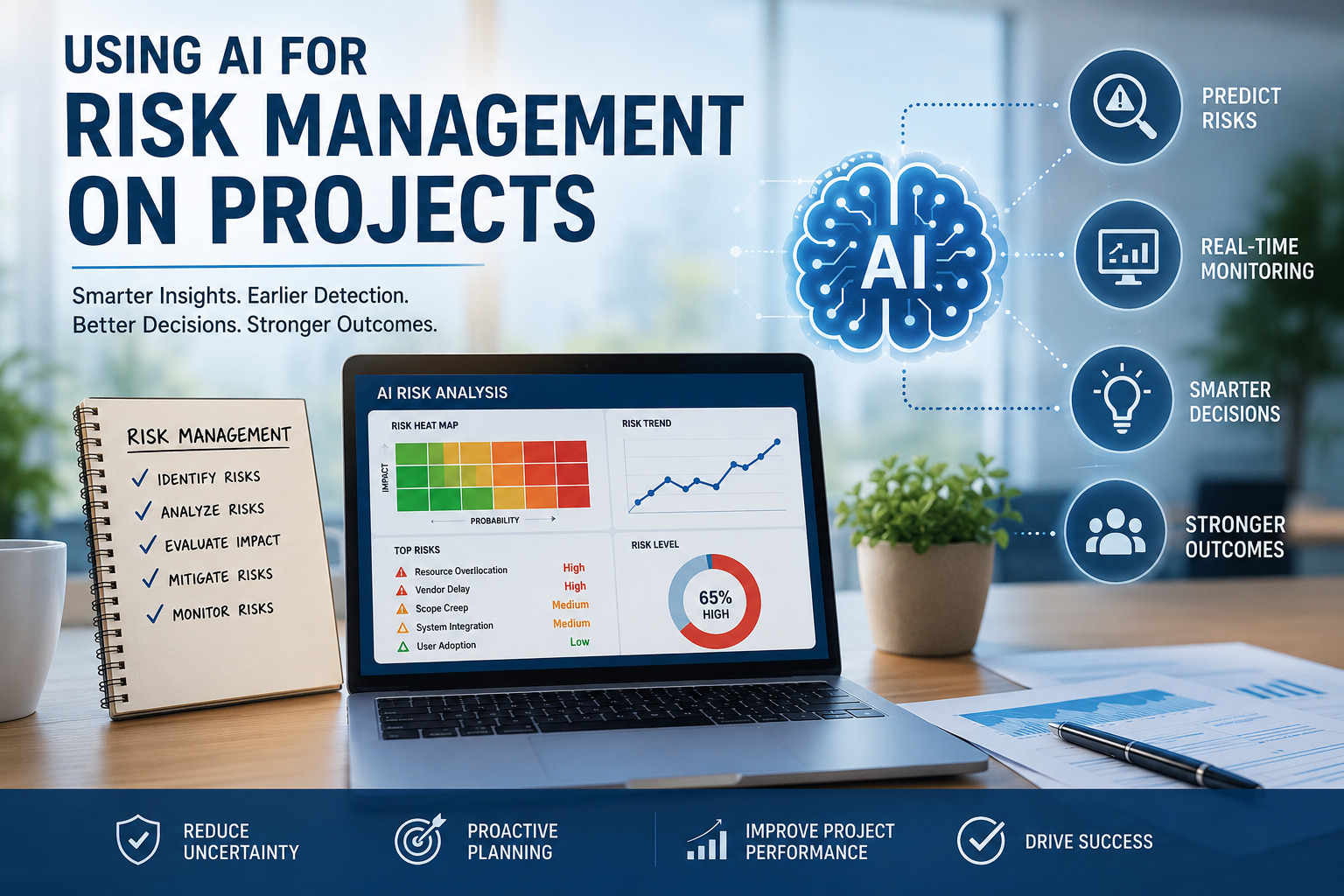
Risk management is one of the most important responsibilities of a project manager. Identifying risks early, tracking them consistently, and responding before they impact timelines or budgets can determine whether a project succeeds or struggles.
Artificial Intelligence (AI) is becoming a practical tool that project managers can use to strengthen risk management processes, improve visibility, and make faster decisions throughout the project lifecycle.
Rather than replacing project managers, AI helps teams identify trends, analyze data faster, and proactively manage project uncertainty.
Why Traditional Risk Management Falls Short
Many project teams still manage risks manually using spreadsheets, static risk registers, and periodic status meetings. While these methods can work, they often create several challenges:
- Risks are identified too late
- Risk registers become outdated
- Teams rely heavily on manual reporting
- Trends are difficult to identify quickly
- Leadership lacks real-time visibility
- Teams become reactive instead of proactive
AI helps solve many of these challenges by automating analysis, monitoring project data continuously, and surfacing risks earlier.
Practical Ways AI Can Improve Project Risk Management
1. Predicting Project Delays Before They Happen
AI tools can analyze:
- Historical project schedules
- Resource allocation patterns
- Vendor performance
- Ticket trends
- Task completion rates
- Budget burn rates
The system can then identify patterns associated with delays or operational issues.
For example, if projects involving multiple integrations historically experience schedule overruns, AI can flag those workstreams as high-risk early in planning.
This allows project managers to:
- Add contingency time
- Reallocate resources
- Increase monitoring frequency
- Escalate concerns earlier
- Improve stakeholder communication
2. Improving the Risk Register
Maintaining a risk register manually often becomes a “check-the-box” exercise. AI can make risk registers more dynamic and actionable.
AI-assisted risk management platforms can:
- Recommend common risks based on project type
- Categorize risks automatically
- Suggest mitigation strategies
- Detect duplicate risks
- Flag inactive or stale risks
- Recalculate risk exposure as project conditions change
This creates a living risk management process instead of a static document that is rarely reviewed.
3. Real-Time Risk Monitoring
One of the biggest advantages of AI is continuous monitoring.
Instead of waiting for weekly meetings, AI tools can monitor project health in real time by analyzing:
- Schedule variance
- Budget variance
- Resource utilization
- Incident trends
- Communication activity
- Help desk ticket volume
- System performance metrics
When thresholds are exceeded, alerts can be generated immediately.
Examples include:
- Resource overallocation
- Tasks repeatedly slipping
- Increased incident volume during implementations
- Reduced stakeholder engagement
- Budget consumption exceeding planned thresholds
This allows project managers to respond before issues become major project impacts.
4. Supporting Better Executive Reporting
Leadership teams often need concise, actionable project updates. AI can help generate:
- Executive summaries
- Risk heat maps
- Trend analysis dashboards
- RAID summaries
- Forecasting reports
- Resource risk indicators
This improves visibility for leadership and helps executives make faster decisions based on current project conditions.
For large organizations managing multiple initiatives simultaneously, AI-assisted reporting can significantly reduce administrative overhead.
5. Strengthening Healthcare Project Management
In healthcare environments, project risk management becomes even more critical due to operational and patient care impacts.
Healthcare projects often involve risks related to:
- Downtime during implementations
- Clinical workflow disruption
- Integration failures
- Staffing shortages
- Training adoption
- Cybersecurity threats
- Regulatory compliance
AI can help identify early warning indicators by analyzing operational and project-related data.
Examples include:
- Increased support tickets after a rollout
- Low training completion rates
- Performance degradation during infrastructure changes
- Resource conflicts across departments
- Delays in vendor deliverables
By identifying these trends earlier, project teams can implement mitigation strategies before operational impacts occur.
Tactical Best Practices for Using AI in Risk Management
Organizations should approach AI as a support tool within an established project management framework.
Some practical best practices include:
Maintain a Strong Risk Management Process
AI works best when organizations already have structured processes for:
- Risk identification
- Escalation
- Mitigation planning
- Governance
- Reporting
Keep Risk Registers Updated
AI recommendations are only valuable if project data is accurate and current.
Use AI to Support — Not Replace — Leadership
AI can identify trends and generate recommendations, but experienced project managers still provide critical judgment, communication, and decision-making.
Focus on Actionable Metrics
Avoid overwhelming teams with unnecessary dashboards or alerts. Focus on measurable indicators tied directly to project performance and operational risk.
Continuously Review AI Recommendations
AI models improve over time, but project teams should continuously validate outputs and refine thresholds based on organizational experience.
Final Thoughts
AI is rapidly becoming a valuable tool for modern project managers. Organizations that leverage AI effectively can improve visibility, reduce uncertainty, and respond to risks faster than traditional approaches alone.
The combination of experienced project leadership and AI-driven insights creates a stronger, more proactive risk management strategy.
Project managers who understand how to integrate AI into planning, monitoring, and reporting processes will be better positioned to lead complex projects successfully in the years ahead.
Brian Bond of Boerne is an IT Project Manager and technology leader with experience in healthcare IT, infrastructure, risk management, and enterprise project delivery. Learn more at BrianBondPMP.com.